
Hydration+
Hypotonic
Lower concentration than body fluids.PURR's lighter electrolyte profile for everyday hydration and shorter sessions.
The science behind PURR
Exercise duration, intensity and conditions influence fluid and electrolyte needs. PURR translates that reality into two 500 ml formulas with distinct electrolyte profiles.
Discover the difference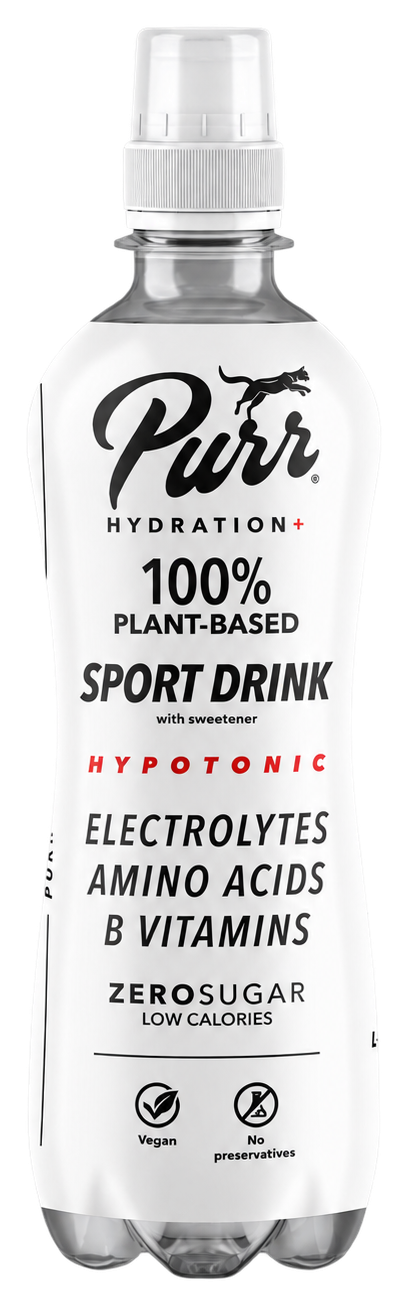
Hypotonic
Lower-concentration electrolyte profile.
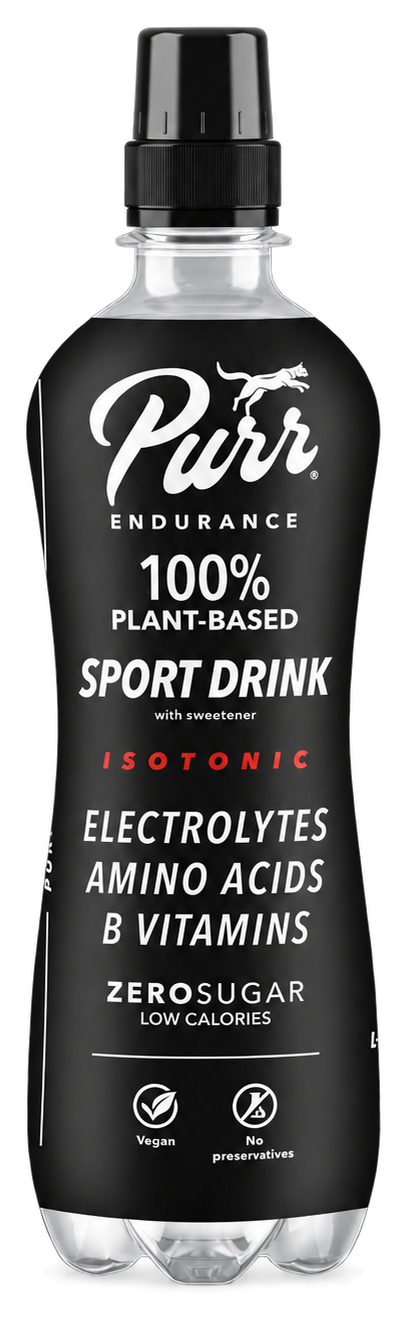
Isotonic
Higher-sodium electrolyte profile.
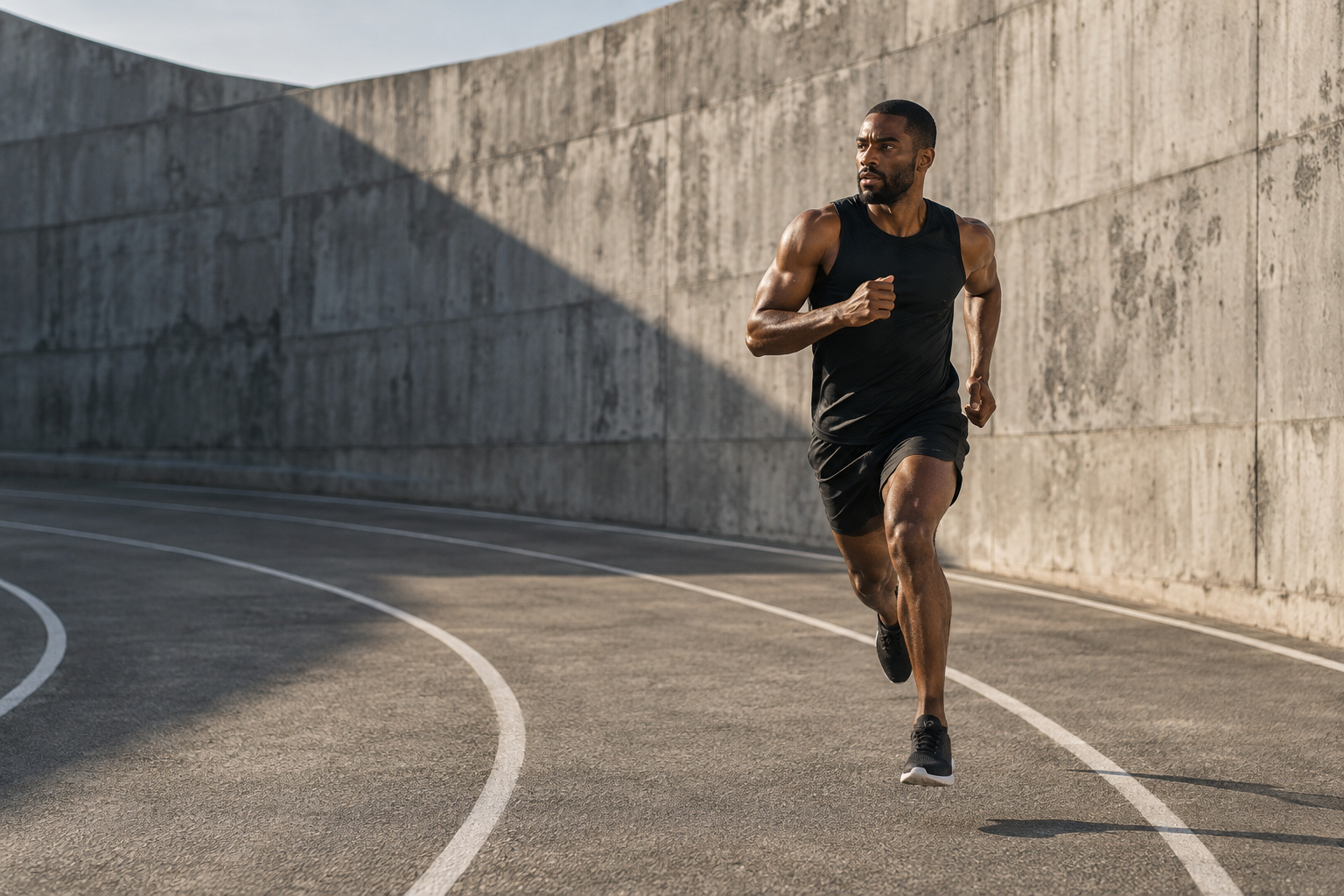
PURR science in motion
Start with the film. Then explore the formulas, ingredients and research at your own pace.
The film is temporarily unavailable. Please try again later.
Discover the science behind PURR.
Open film ↗︎Two formulas. One shared core.
The difference is concentration.
Hypotonic and isotonic describe a drink's concentration of dissolved particles compared with body fluids. Neither is inherently better; each profile is designed for a different context.
Hypotonic
Lower concentration than body fluids.PURR's lighter electrolyte profile for everyday hydration and shorter sessions.
Isotonic
Concentration close to body fluids.PURR's higher sodium profile for prolonged or higher intensity sessions.
Hypotonic Isotonic
Different concentration. Different purposes. Different profiles for different demands.
Five charged minerals
Electrolytes are minerals that form electrically charged particles, ions, when dissolved in water. They are naturally present in body fluids.
PURR uses five charged minerals. One electrolyte system.
The main electrolyte lost in sweat; central to fluid balance.
Works with sodium in fluid regulation and electrical signalling.
Involved in muscle function and energy metabolism.
Involved in muscle contraction and nerve signalling.
Works alongside sodium in fluid and acid-base balance.
The science behind PURR
4 amino-acid ingredients and derivatives, studied for their roles in energy production, muscle function, circulation and recovery.
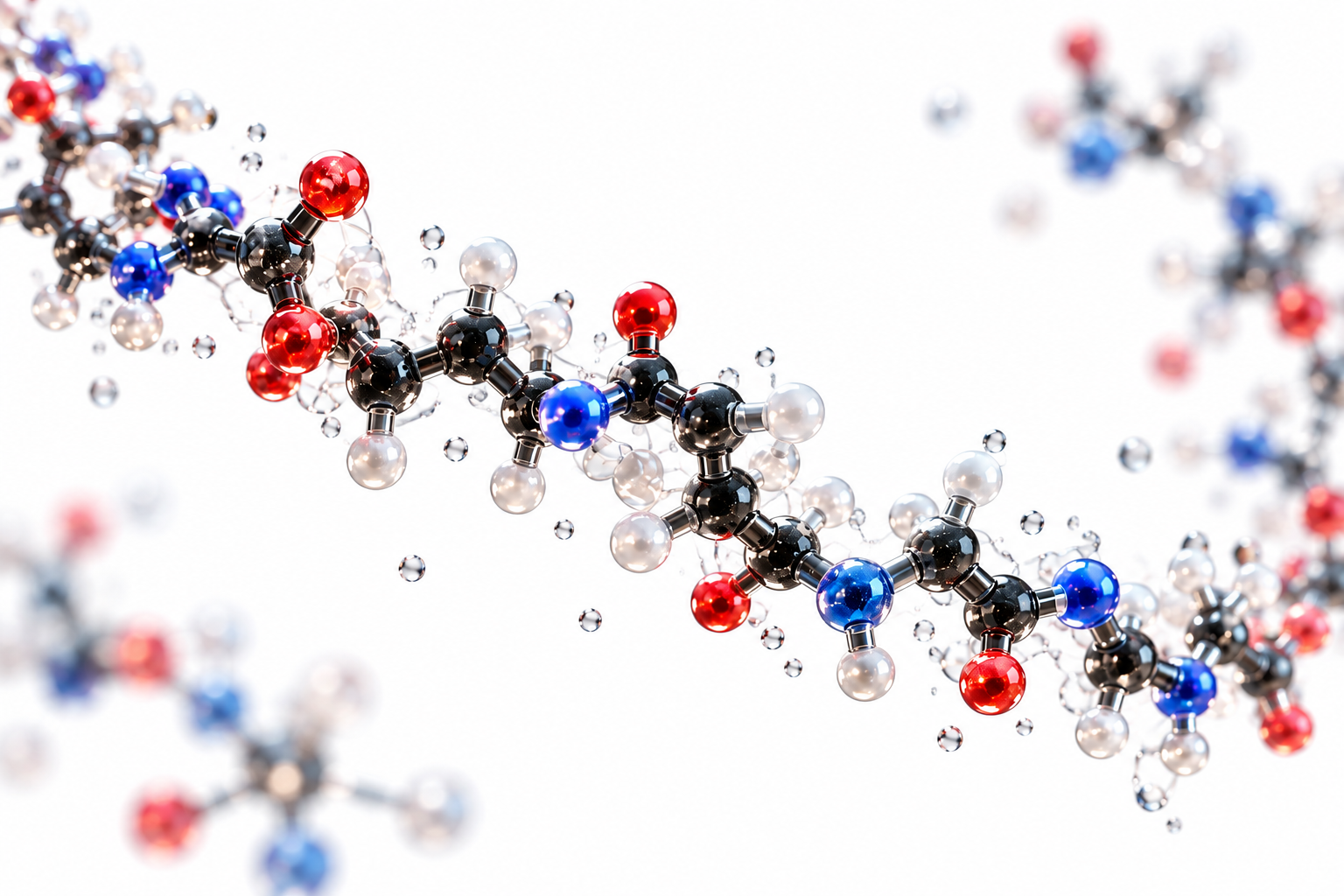
Four ingredients. One formula.
A form of carnitine used in the body’s energy pathways.
What it is. Acetyl-L-carnitine is a form of carnitine, a naturally occurring compound involved in cellular energy metabolism. The carnitine system is involved in the use of fatty acids for energy.
Sports nutrition context. Carnitine compounds are studied in sports nutrition because of their metabolic roles. This describes the ingredient’s biological context, rather than demonstrating a performance effect from the finished drink.
Used by the body to make carnosine, a natural compound in muscle.
What it is. Beta-alanine is a non-essential amino acid that the body uses to make carnosine, a compound found in muscle.
Sports nutrition context. Beta-alanine is studied in relation to muscle carnosine and repeated or high-intensity exercise. Research depends on the daily amount and duration of use; 500 mg in one bottle should not be equated with a studied supplementation programme.
Converted by the body into arginine, another amino acid.
What it is. L-citrulline is an amino acid converted into arginine, which participates in nitric oxide pathways linked to blood flow.
Sports nutrition context. L-citrulline appears in sports nutrition formulas because researchers study these pathways in relation to exercise. Findings vary with the ingredient form, amount and study design.
One of the body’s most abundant amino acids, used by many cells.
What it is. L-glutamine is an amino acid used by many cells and involved in a range of metabolic processes.
Sports nutrition context. Glutamine is studied in exercise and recovery research. Evidence for improved sporting performance is limited, and an ingredient’s presence does not establish an effect from the finished drink.
Context matters. Research tests specific ingredients at specific doses, over specific periods.
An ingredient’s presence alone does not guarantee a performance effect.
B-vitamin complex
PURR contains:
B1, B2, B3, B6 and B12 contribute to normal energy-yielding metabolism.
B2, B3, B6 and B12 contribute to the reduction of tiredness and fatigue.
B1, B2, B3, B6 and B12 contribute to the normal functioning of the nervous system.
Inside the formula
Explore every ingredient, amount and nutrition detail.
The science behind PURR
PURR is informed by research in hydration, electrolytes and sports nutrition. Explore the sources behind our approach.
Scientific references / 01
How exercise and conditions influence hydration needs.
Hydration needs change with exercise duration and intensity, individual sweat rate, environmental conditions and access to fluids. These references explain why hydration strategies should be matched to the person and the situation.
Sawka MN et al. · Medicine & Science in Sports & Exercise
Guidance on fluid replacement before, during and after exercise.
Read sourceMcDermott BP et al. · Journal of Athletic Training
Practical guidance on individual sweat losses, underdrinking and overdrinking.
Read sourceKenefick RW · Sports Medicine
How duration, intensity, heat and sweat rate influence drinking strategy.
Read sourceSawka MN, Cheuvront SN & Kenefick RW · Sports Medicine
How environmental conditions influence the effects of body-water loss.
Read sourceNuccio RP et al. · Sports Medicine
Fluid balance and hydration effects across team-sport settings.
Read sourceRacinais S et al. · British Journal of Sports Medicine
Hydration planning, heat acclimation and risk management in hot conditions.
Read sourceReference note These publications examine hydration principles and do not constitute clinical testing of the finished PURR drinks.
Scientific references / 02
How sweat changes fluid and electrolyte needs.
Sweat loss varies widely between people and conditions. It removes water and electrolytes, mainly sodium and chloride, so replacement needs depend on sweat rate, sweat composition, exercise duration and environment.
Baker LB · Temperature
How sweat is produced and what determines its electrolyte composition.
Read sourceBaker LB · Sports Medicine
Why sweat rate and sodium concentration differ between people and sessions.
Read sourceBaker LB et al. · Journal of Sports Sciences
Reference data showing wide variation across trained athletes.
Read sourceShirreffs SM & Maughan RJ · American Journal of Physiology
How water and sodium influence restoration of fluid balance after exercise.
Read sourceEvans GH et al. · Journal of Applied Physiology
Research on restoring and maintaining fluid balance after dehydration.
Read sourceHew-Butler T et al. · Clinical Journal of Sport Medicine
Why hydration strategies must avoid both insufficient and excessive fluid intake.
Read sourceReference note These publications examine sweat and electrolyte principles and do not constitute clinical testing of the finished PURR drinks.
Scientific references / 03
How hypotonic and isotonic drinks differ in concentration.
Hypotonic drinks have a lower concentration of dissolved particles than body fluids; isotonic drinks are formulated closer to that concentration. Osmolality, ingredient type and ingredient amount can influence how a drink leaves the stomach and how water and solutes move through the intestine. The complete formula and conditions of use still matter.
Rowlands DS et al. · Sports Medicine
Evidence comparing hypotonic, isotonic and hypertonic drinks during continuous exercise.
Read sourceLeiper JB · Nutrition Reviews
How drink composition and exercise conditions influence fluid delivery.
Read sourceVist GE & Maughan RJ · The Journal of Physiology
How carbohydrate content and dissolved-particle concentration affect stomach emptying.
Read sourceGisolfi CV et al. · Journal of Applied Physiology
How carbohydrate type and concentration shape water uptake in the intestine.
Read sourceHunt JB et al. · Gut
Evidence on water and solute uptake from hypotonic glucose-electrolyte solutions.
Read sourceMaughan RJ & Leiper JB · Canadian Journal of Applied Physiology
How drinking rate, gastric emptying and absorption limit fluid replacement.
Read sourceReference note These publications examine concentration and fluid-delivery principles and do not constitute clinical testing of the finished PURR drinks.
Scientific references / 04
Research on selected amino acids and B vitamins used in PURR.
PURR combines four amino-acid ingredients and derivatives—acetyl-L-carnitine, beta-alanine, L-citrulline and L-glutamine—with vitamins B1, B2, B3, B6 and B12. These references explain what scientists study and why these ingredients appear in sports nutrition. Results depend on dose, duration, population and the complete formulation.
Rebouche CJ · Annals of the New York Academy of Sciences
How acetyl-L-carnitine is absorbed, distributed and metabolised in the body.
Read sourceTrexler ET et al. · Journal of the ISSN
Evidence on beta-alanine, muscle carnosine and exercise outcomes at studied doses.
Read sourceGonzalez AM & Trexler ET · Journal of Strength & Conditioning Research
A review of human research on L-citrulline and exercise outcomes.
Read sourceCoqueiro AY et al. · Nutrients
Research on glutamine, fatigue markers and the limited evidence for performance effects.
Read sourceWoolf K & Manore MM · International Journal of Sport Nutrition & Exercise Metabolism
How B-vitamin status relates to metabolism and the needs of active people.
Read sourceEFSA NDA Panel · EFSA Journal
EFSA assessment of vitamin B6 in normal energy metabolism and tiredness.
Read sourceReference note These sources concern individual ingredients and studied doses—not the finished PURR drinks. Any vitamin claim depends on final amounts meeting applicable EU conditions of use.
Sodium chloride + trisodium citrate
What it isSodium is one of the body’s main electrolytes. It is involved in fluid balance, nerve signalling and muscle function.
Why it is used in sports nutritionSodium is the main positively charged electrolyte lost in sweat. Sweat losses vary with the person, exercise duration and conditions, making sodium especially relevant during longer sessions or when sweating is heavier.
Kłodawska rock salt from Kłodawa, central Poland. Naturally sourced, with 98% sodium chloride.
Potassium chloride + tripotassium citrate
What it isPotassium is an electrolyte found mainly inside cells. It is involved in fluid balance, normal nerve signalling and normal muscle function.
Why it is used in sports nutritionPotassium is included as part of the broader electrolyte profile, alongside sodium and chloride. Sports nutrition research considers these minerals in relation to sweat losses and fluid replacement.
Magnesium citrate
What it isMagnesium is an essential mineral and electrolyte involved in normal muscle function, nervous-system function and energy metabolism.
Why it is used in sports nutritionMagnesium is included as part of the drink’s broader mineral profile. Muscle function, electrolyte balance and energy metabolism are relevant to training and exercise.
Tricalcium citrate
What it isCalcium is an essential mineral involved in normal muscle function, cell signalling and the maintenance of normal bones.
Why it is used in sports nutritionCalcium is included as part of the broader mineral profile. Its role in muscle function is relevant to exercise, and it completes PURR’s five-mineral electrolyte system.
Sodium chloride + potassium chloride
What it isChloride is one of the body’s main electrolytes. It works alongside sodium and potassium in fluid balance and the body’s electrolyte system.
Why it is used in sports nutritionChloride is lost in sweat alongside sodium. It is included with sodium and potassium as part of a multi-mineral electrolyte profile.
Both formulas. The same B-vitamin blend.
What it isThiamine is a water-soluble B vitamin involved in normal energy metabolism. It helps the body use energy from food, including carbohydrates, and supports normal nervous-system function.
Why it is used in sports nutritionVitamin B1 forms part of the B-vitamin blend because normal energy metabolism is relevant during physical activity.
B vitamins are water-soluble micronutrients. They help the body use energy from food; they do not supply calories themselves.
Both formulas. The same B-vitamin blend.
What it isRiboflavin is a water-soluble B vitamin involved in normal energy metabolism. It plays a role in the metabolism of carbohydrates, fats and proteins.
Why it is used in sports nutritionVitamin B2 forms part of the B-vitamin blend, contributing to normal energy-yielding metabolism and the reduction of tiredness and fatigue.
B vitamins are water-soluble micronutrients. They help the body use energy from food; they do not supply calories themselves.
Both formulas. The same B-vitamin blend.
What it isNiacin is a water-soluble B vitamin involved in normal energy metabolism and normal nervous-system function.
Why it is used in sports nutritionVitamin B3 forms part of the B-vitamin blend, contributing to normal energy-yielding metabolism and the reduction of tiredness and fatigue.
B vitamins are water-soluble micronutrients. They help the body use energy from food; they do not supply calories themselves.
Both formulas. The same B-vitamin blend.
What it isVitamin B6 is a water-soluble vitamin involved in normal protein and glycogen metabolism, energy metabolism and nervous-system function.
Why it is used in sports nutritionVitamin B6 is included in the B-vitamin blend because of its roles in normal nutrient metabolism, including the body’s use of amino acids.
B vitamins are water-soluble micronutrients. They help the body use energy from food; they do not supply calories themselves.
Both formulas. The same B-vitamin blend.
What it isVitamin B12 is a water-soluble vitamin that contributes to normal red blood cell formation, nervous-system function and energy metabolism.
Why it is used in sports nutritionVitamin B12 forms part of the B-vitamin blend, contributing to normal energy-yielding metabolism and the reduction of tiredness and fatigue. Red blood cells carry oxygen around the body.
B vitamins are water-soluble micronutrients. They help the body use energy from food; they do not supply calories themselves.
Both formulas · 500 ml
Five electrolytes, four functional ingredients and five B vitamins. Explore the flavour system and the full nutrition details for each formula.
PURR pairs natural citrus flavourings with stevia-based sweetness. Both Hydration+ and Endurance combine lemon, orange and grapefruit in a bright, balanced citrus taste profile.
Flavour qualityNatural flavour preparations are selected for consistency and a fresh citrus character in the finished beverage.
Plant-based sweetnessSteviol glycosides from stevia provide sweetness without adding sugar. The sweetening system is selected for a clean, sugar-like taste, with reduced bitterness and less lingering aftertaste so the citrus profile stays clear.
| Nutritional information | Per 100 ml | Per 500 ml |
|---|---|---|
| Energy | 28 kJ / 6 kcal | 140 kJ / 30 kcal |
| Fat | 0 g | 0 g |
| of which saturates | 0 g | 0 g |
| Carbohydrates | 1.6 g | 8.1 g |
| of which sugars | 0 g | 0 g |
| Protein | 0.1 g | 0.4 g |
| Salt | 0.29 g | 1.43 g |
| Vitamin B1 (thiamine) | 0.11 mg (10% NRV) | 0.55 mg (50% NRV) |
| Vitamin B2 (riboflavin) | 0.14 mg (10% NRV) | 0.7 mg (50% NRV) |
| Niacin (vitamin B3) | 1.5 mg (9% NRV) | 7.5 mg (47% NRV) |
| Vitamin B6 (pyridoxine) | 0.2 mg (14% NRV) | 1 mg (71% NRV) |
| Vitamin B12 (cobalamin) | 0.25 μg (10% NRV) | 1.25 μg (50% NRV) |
Ingredients: Water, acidity regulators: citric acid, malic acid, minerals (sodium citrate, calcium salts of citric acid, magnesium salts of citric acid, potassium citrate, potassium chloride), acetyl-L-carnitine, L-citrulline malate, beta-alanine, L-glutamine, natural citrus flavourings, sweetener: steviol glycosides from stevia, vitamins (B1, B2, niacin, B6, B12).
NRV = Nutrient Reference Values.
| Nutritional information | Per 100 ml | Per 500 ml |
|---|---|---|
| Energy | 21 kJ / 5 kcal | 105 kJ / 25 kcal |
| Fat | 0 g | 0 g |
| of which saturates | 0 g | 0 g |
| Carbohydrates | 1.2 g | 6.3 g |
| of which sugars | 0 g | 0 g |
| Protein | 0.1 g | 0.4 g |
| Salt | 0.45 g | 2.26 g |
| Vitamin B1 (thiamine) | 0.11 mg (10% NRV) | 0.55 mg (50% NRV) |
| Vitamin B2 (riboflavin) | 0.14 mg (10% NRV) | 0.7 mg (50% NRV) |
| Niacin (vitamin B3) | 1.5 mg (9% NRV) | 7.5 mg (47% NRV) |
| Vitamin B6 (pyridoxine) | 0.2 mg (14% NRV) | 1 mg (71% NRV) |
| Vitamin B12 (cobalamin) | 0.25 μg (10% NRV) | 1.25 μg (50% NRV) |
Ingredients: Water, acidity regulators: citric acid, malic acid, minerals (sodium citrate, calcium salts of citric acid, magnesium salts of citric acid, potassium citrate, potassium chloride), acetyl-L-carnitine, L-citrulline malate, beta-alanine, L-glutamine, natural citrus flavourings, sweetener: steviol glycosides from stevia, vitamins (B1, B2, niacin, B6, B12).
NRV = Nutrient Reference Values.
PURR

Plant-based performance hydration for everyday movement and longer efforts. Two targeted formulas. Zero sugar. Ready to drink.
Plant-based performance hydration for everyday movement and longer efforts. Two targeted formulas. Zero sugar. Ready to drink.